STORY PAGE
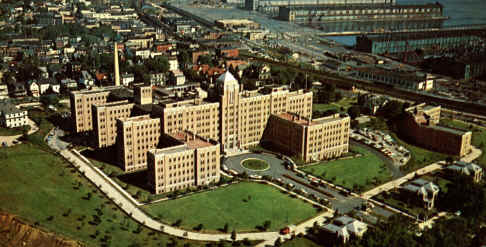
The Marine Hospital
It was big. Possibly
modern in those days, but compared with that which I have since seen, slightly better than witchcraft. I cannot remember exactly why I had gone there, but I
believe it was originally for a physical. I know I entered somewhere near the end of January of 62 and was there for at least two months.
Shortly after I
entered they ran a series of tests. Then they ran more tests. I had a high white blood count. They did not know why. I felt fine. They placed me in solarium.
It was where they isolated patients with infectious diseases. Within a week, I was really sick.
On one of the
following Fridays it became clear to me that I felt worse about an hour after they gave me my medication. (Probably one of those sleeping pills they woke me
for in the middle of the night.) I told the nurse. She informed me that my doctor had left for the weekend and no other doctor could change my medicine
unless there was an emergency. I faked taking those medicines. The headaches disappeared. Monday morning I told my doctor. He stopped the pills.
I felt good again,
but I still had the high white count. I was moved from solarium to a ward. Things were looking up. I should have known better. I received a call from my
wife. We were legally separated and she was calling from California. What next. She asked me if the results for the leukemia tests had been completed.
Surprise, she knew more than me. (I never did figure that one out.) Before our call was completed, they came to fetch me for a spinal tap. (Most people
think of a spinal as the insertion of a painkiller in the spinal area as a local for an operation. My spinal was
different.)
I was told they
could eliminate or find many possibilities for my high white count by taking a spinal. Primarily, the testing was for leukemia. They explained the procedure.
I would lie on my side on the gurney and stretch into the fetal position. At that time they gave me a wooden dowel to bite on. Any anesthesia would interfere
with the spinal fluid they would draw off. It would be painful, but bearable. I wasn’t too worried until I saw the needle. It would have frightened a
horse.
I bit on the dowel.
I was more fetal than any fetus. I was as ready as I could be. I heard my doctor explain the procedure to the other doctor. I felt the prick and as I was
becoming aware that this was the first time for a student doctor, he hit a vertebra. The one-piece wooden dowel became three pieces. I came off the gurney
with a horse needle in my back. I was ready to kill.
By that time there
were three large attendants, two doctors, and two nurses holding me and placing me back on the gurney. The needle had fallen out. The student doctor
disappeared. Eventually I settled down I was given a new dowel and my doctor performed the procedure himself. I was then told to walk back to my bed. (Today
I wonder if he used the fallen needle?)
My back was sore. The pressure from the removal of the fluid had given me a headache much more painful than the second attempt or the removal of the fluid. (I was told later it would have been worse if I had not walked to my bed.) Most of the pain and headache were gone the next day. When the results came back, they were all negative. I may have felt great, but they didn’t let me go.
Next was the kidney
biopsy. The biopsy room was like a schoolroom of the 40’s and 50’s. Brick outside, plaster inside, with large high windows. I remember vividly, because
they had to dry the condensate on the inside from the cold February weather. They used the window to tape my x-ray onto to view while doing the biopsy. This
time my doctor had about five students.
I listened closely.
This is basically what he said. “Gentlemen. This area you see here on the x-ray is the kidney. If you watch, I will use a red antiseptic to outline it on
the patient’s back.” (I could feel the cold wet fluid as he drew on my back) “I will use the clear antiseptic inside of the red. We know from the x-ray
where the kidney is, but not how deep. However, since the kidney is much tougher, we will use this thin needle to determine its depth like this.” I could
hardly feel the needle enter or touch the kidney. When he asked if any of the others would like to try it, officer or not, I said my piece. I told him
I had already committed my body to all the training it could handle. He understood. I was removed from guinea pig status.
He continued. He
explained the operation of the needle with the little cleaver in the end. I didn’t wish to watch. He marked the depth, inserted the needle, and while I was
assuming that it was painful enough, he pushed the plunger that took a part (sliver) of my kidney. Six pair of hands held me down. I later looked at the
needle. It was metal, about the same size as the one for the spinal tap I had suffered from, except the needle part was 4 times the diameter. This pain also
subsided in a day or two. The test results again were negative. They still wouldn’t let me return to my ship.
Next came the blood
tests for diabetes. First I drank glucose. (Liquid sugar) Then they drew blood every ½ hour, then every hour, until they stopped on the sixth hour. It was
called a “six-hour post-preandial”. (However you spell it) I don’t know how many times that happened. (Too many to count, but I know that all of the
practicing corpsmen strikers practiced on my pincushion arms.) They also placed me on a
special diet. No sugar. (Except for tests) It was four meals a day 2600 calories. I gained weight.
They then held a
physical evaluation board. The board decision was that I was a borderline diabetic. I could have a medical discharge if I wished. If not, I could
return to my ship. I was cleared for duty. Their recommendations to me were not to allow my weight to go above normal, and that I should not carry more than
25 pounds up or down a ladder.
I had been there two
months. I had entered feeling healthy. I had returned the same. In between, I had seen more pain than the remainder of my four-year hitch. (And that included
removal of my wisdom teeth without Novocain.) The board was split as to its decision that I was a borderline diabetic. When I asked my doctor he said, “If
you become a civilian and fill out a medical form asking if you are a diabetic, put down No.”
A later note: In my sixties, and with the advent of a new test to measure sugar and disbursement over 6 months, I am again watching my diet and taking home readings for a borderline diabetes.
 | |
|