STORY PAGE
The Sonar Contact
Although my most frequent duties aboard the Spencer were standing Radar watches, my rate was that of a Sonarman. In addition to my training I possessed the one item that cannot be taught, excellent hearing with the ability to discern the smallest of changes in pitch.
The major periods that I used my sonar rating were during drills, or 0900 each weekday at sea when I made the standard procedural check of the ANSQS-11 sonar and it's associated equipment. The finest of the WWII systems, it was obsolete by U. S. Navy standards, but at close range and with a competent Sonarman it was unrivaled.
We were on Ocean Station in the mid Atlantic. During one such procedural check I encountered a Sonar Contact. Regardless of the situation, a Sonar Contact for any reason involves informing the bridge and running a plot. This is done in C.I.C. (Combat Information Center) where the sonar was located.
The bridge was informed of that contact. One of the watch was running a plot and preliminary indications were that this was a moving target with a metallic surface. The bridge acknowledged same and asked CIC to continue the plot and confirm.
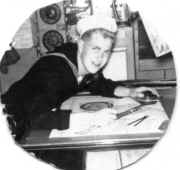
Running a plot under the best conditions utilized a minimum of three people. The sonar operator to give the target bearing and sound interpretation, a person on the Range Recorder to give a range at the same time as the sonar operator gave the bearing, and a third person to use bearing and range to run a plot on the DRT. The DRT had a large plotting surface that used the ships gyro and speed indicators, and could keep a running position of the Spencer. The end result was, when the bearing and distance were given, the target would be positioned and the time indicated. This allowed the DRT operator to calculate a series of positions and times, to give a course and speed of the target. (It must be noted that any incorrectness of bearing, range, plot, timing, or mistake in calculation would negatively effect that plot. However, the longer the plot, the less chance for mistakes, and a greater chance for accurate information.)
My report back to the bridge was that the target was presumed to be metal, it's course erratic, and its speed was (I will not tell you, except to say much faster than any CG cutter could travel at that time.) I also clarified that it was not a false target. After additional plotting with the same results, the bridge told us to break off the plot, that the contact was not a submarine, it was too fast, and too erratic.
I asked if I could try to make contact with our Gertrude, a vintage underwater telephone of sorts. Permission was granted, but still no results. Supposedly Com Fleet had been questioned and advised that there were no submarines in our area. The plot was officially broken off.
Well, if there were no sub, it would not hurt if I used the sonar key and Morse Code to key something like, "This is the CGC Spencer and if you do not respond we will blow you the @#*~ out of the water”, and I did.
Shortly after, there was a blip on the surface search radar. Next, there was an influx of radio communication. Rumor has it that a nuclear submarine was doing ASW drills in the area and asking us to “cease any aggressive actions“, but then again, this is just a story.
 | |
|